

Inventory Management Pyramid. Processes and benefits from robust inventory management.
Part 1 explored the Core Principles of Inventory Management, focusing on day-to-day work such as forecasting, movement of goods, and reorder processes. On top of these foundational workflows, a Sales Inventory & Operations Planning (SIOP) process that increases organizational engagement & supply chain resilience, delivering high customer satisfaction.
Organizations with strong SIOP processes are nimbler in their responses to external forces facing supply chains face. They also distinguish themselves from those in their segment without a SIOP process. Beyond operations, it enables the Sales & Marketing Teams the opportunity to develop a unique brand identity as they represent the capabilities inherent in SIOP organization.
Mature SIOPs have a proactive feedforward mechanism that reduces the level and frequency of unplanned events and crises. The initial development of a SIOP program requires leadership work collaboratively across functions to tie top level strategies and decisions back to day-to-day work. Actions flow through defined workflows, keeping day-to-day targets clear and meaningful. When priorities change, the team on the floor understands “why” the changes are being made. It is not ad-hoc, rather by design. SIOP contains top-down guidance to operations and sales that aligns the organization. Subsequent forecast adjustments and inventory management actions are aligned. If you think SIOP is an academic discussion, consider which companies have best dealt with the recent EV trends. It stands to reason a strong SIOP process is in place in those organizations.
There is little doubt that automobile manufacturers have highly complex supply chains. Every several minutes a new vehicle that contains 100,000 parts sources from 1,000 suppliers rolls off a Just-In-Time-Sequenced (JITS) supply scheme. While automation makes this possible, what happens when an EDI falls apart? Chaos can be measured by the length of time a final assembly line is off the EDI. SIOP provides tier suppliers the right information to make the best decisions while waiting for the OEMs to reinstitute the EDI. So, what does the SIOP decision process look like? While a series of discreet decisions can be mapped to different scenarios, do we really want the supply chain manager with 18 months of floor time making the calls? Maybe, but it really starts with understanding the risks levels. Implementing a simple approach to managing risks is intrinsic to SIOPs. While the levels of decision need to be quantified in your organization, the information needed and the people who need to make the decision fit nicely into this 3-tier model:
At each level, there are clearly defined decision matrices and escalation levels. Sponsors should be in place to ensure the designated teams have the proper organizational support and also benefit from the organizational learning in the past. Using old scenarios where customer satisfaction is a great place to face the reality that all functions have to work together to deliver the best possible results.
As the risk increases, communications with customers and suppliers using metrics and pre-planned communications plans are at the heart of world-class supply management. While no one likes to deliver “bad news”, however “no news” can lead to decisions made without relevant but unavailable information. This loses trust and can fracture long-standing supply chains.
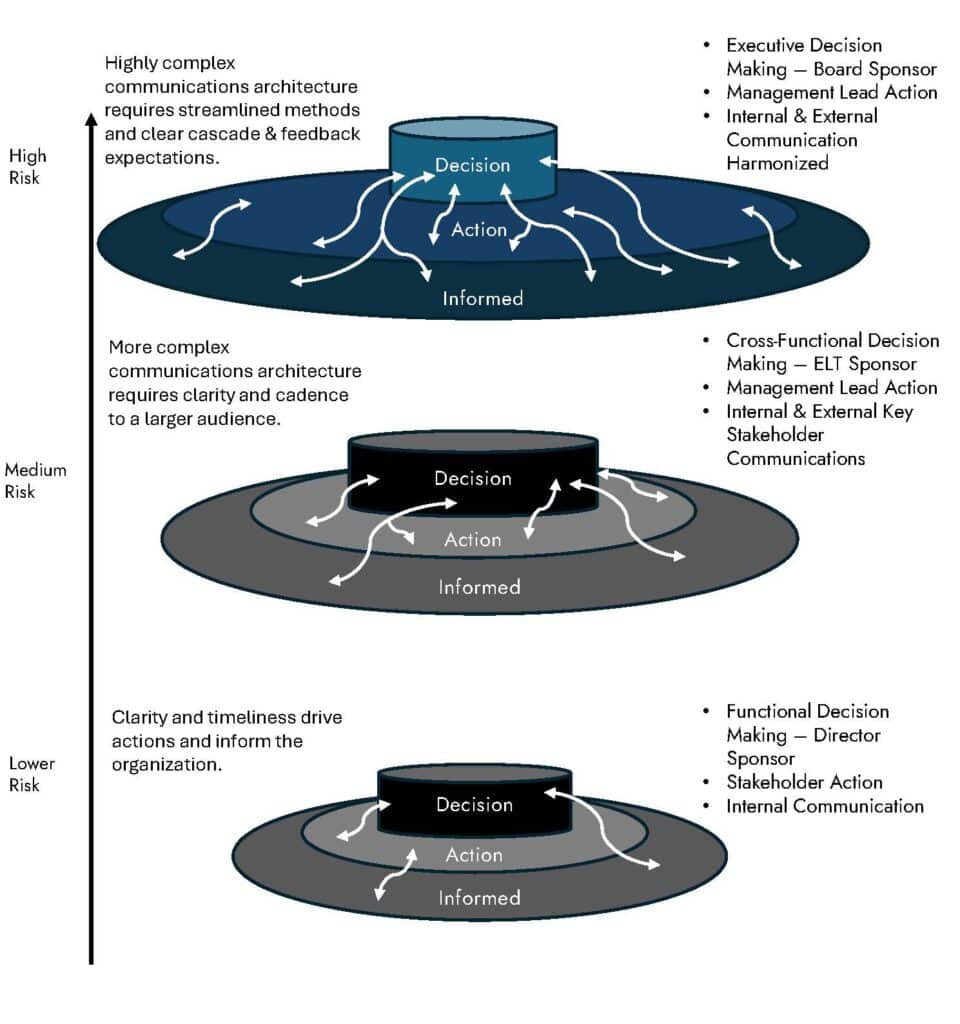
SIOP Enabled Risk Management Model
Effective stock level optimization requires evaluating inventory turnover rates, identifying fast-moving and slow-moving items, and prioritizing inventory based on their value and impact. Techniques such as ABC analysis, which categorizes inventory by importance, can help focus efforts on critical goods. In addition, safety stock strategies serve as a safeguard against demand variability, ensuring uninterrupted operations.
Inventory management techniques such as ABC analysis or the expanded ABC-XYZ method are invaluable for prioritizing resources and establishing order frequency. ABC analysis categorizes items by their value and impact, while ABC-XYZ combines consumption value with demand variability, enabling businesses to refine their planning based on reliability and importance. These techniques help organizations optimize reordering cycles, minimize excess inventory, and ensure essential items are always available, bolstering resilience and scalability.
An optimized warehouse layout is pivotal to improving inventory management efficiency. Practices such as FIFO (First-In, First-Out) and LIFO (Last-In, First-Out) facilitate proper inventory rotation, minimizing waste and obsolescence. Additionally, leveraging vertical storage solutions, automated shelving, and smart technology can maximize space utilization and streamline order fulfillment processes.
Warehouse layout design must integrate the physical processes inherent to inventory procedures, ensuring that every step is streamlined for efficiency. Lean techniques have introduced remarkable improvements, such as reducing travel time within warehouse locations and stages. These enhancements not only optimize movement but also minimize delays in inventory handling. By simplifying key inventory moves, businesses can create a seamless flow of operations, reduce bottlenecks, and enhance accuracy.
Additionally, leveraging advancements in visual recognition systems can significantly improve the identification of part numbers and storage locations. Such systems help workers quickly locate items without manual searches, thereby enhancing speed and precision. Automating processes like recording empty storage locations, integrated with cycle counting routines, ensure real-time updates and supports inventory accuracy.
The ultimate goal of these innovations is to align warehouse design and inventory practices, creating an environment where both accuracy and effort are maximized. This holistic approach empowers organizations to maintain fluid operations while reducing manual intervention, paving the way for cost-effective and scalable inventory management solutions.
Adopting a systematic approach to inventory management yields measurable benefits, including:
While SIOP provides next-level results, it requires an organization must have successfully addressed the complexities of inventory management to establish a strong foundation. Inventory management discipline and making procedures easy and transparent to up-stream processes by design, during every minute of every shift. This can be achieved by timely and accurate input (or capture) of transactions and empowers decision making based upon good data that in turn creates transparency in the supply chain.
Investing in the training and development of personnel is paramount, particularly those involved in aspects such as inventory tracking, demand forecasting, and communicating effectively with suppliers. Properly trained staff not only reduce errors but also enhance adaptability to modern technologies, fostering a culture of efficiency, trust and innovation not compartmentalization and fear.
Effective inventory management transcends mere stock monitoring; it is a comprehensive, strategic approach encompassing demand forecasting, inventory tracking, efficient reordering, and stock optimization. By understanding customer needs, leveraging advanced technologies, and optimizing warehouse operations, organizations can develop next level business performance via a SIOP process that achieve operational excellence and sustainable growth. A well-executed inventory management strategy transforms inventory from a logistical challenge into a competitive advantage that customers value.